Q1 2026 review of DALI strategies and major asset classes.
It was a poor quarter for many asset classes, with the large exception of commodities, with the WisdomTree Continuous Commodity Index Fund (GCC) gaining more than 13%. International equities cooled off in the back half of the quarter, but the SPDR MSCI ACWI ex-US ETF (CWI) still put together a solid quarter as it gained 2.4%. Meanwhile, domestic equities were a point of weakness, seeing the iShares Core S&P Total US Stock Market ETF (ITOT) fall -3.4% on the quarter. DALI (Dynamic Asset Level Investing) is designed to help identify where strength (or weakness) resides across and within the broad asset classes. Domestic equity weakness saw the group fall from first to as low as third in DALI's rankings. Commodities surged in strength in to the top of DALI's rankings, but faltered near the end of March to drop to third place, leaving international and domestic equities in first and second, respectively. DALI's overweight top three assets remain firmly risk-on for the time being, especially as risk-off areas like fixed income and cash sit in the bottom half of rankings.
Using DALI's rankings, we can put together a variety of tactical strategies. Currently, most tactical models remain overweight both international and domestic equities, with some potential exposure to commodities as well. The following strategies are among the most popular, with their rules defined below.
DALI Allocation Strategies
DALI No Bogey: One of the most basic strategies, DALI No Bogey, assumes owning the top two ranked asset classes in an equal-weighted fashion.
DALI with Bogey: Like the DALI No Bogey strategy, DALI with Bogey owns the top two ranked asset classes, but it also employs the Cash Bogey Check. If one of the two asset classes “Fails” that Cash Bogey Check, cash replaces it in the portfolio allocation.
3-Legged Stool: The 3-Legged Stool Strategy, as the name implies, consists of three slices. Two of the slices (or legs) are allocated to the top two asset classes emphasized in DALI, and the third leg is designed to be a constant equity exposure. Within this strategy, the managed equity exposure can take on a different meaning for each, but it is one way to further customize DALI by using individual stocks, ETFs, mutual funds, UITs, or a combination of all.
DALI Tactical Allocation: The Tactical Allocation, or 6-Legged Stool as this strategy has come to be known in some circles, is a strategy where 15% of the portfolio is allocated to domestic equities, international equities, commodities, and fixed income. That accounts for 60% of the portfolio. The other 40% is split between the top two emphasized asset classes in DALI. This has the effect of always maintaining exposure to four asset classes and then using DALI to know which asset classes to overweight.
DALI Flexible Allocation: In the DALI Flexible Allocation Strategy, each asset class is weighted in the portfolio based on the percent of total "buy signals" the asset class maintains relative to the current sum of "tally" signals. In this strategy, you are always maintaining exposure to all six asset classes, but the weights of those asset classes are determined by their strength.
DALI Tactical Tilt Allocation: Our Tactical Tilt program was designed to begin with a strategic target in mind, perhaps something along the lines of 60% stocks and 40% other "stuff" and then establish ranges within which the portfolio can adapt. As our research over the past years has proven, those ranges must be wide enough to allow real adaptation to take place but narrow enough to avoid the common complaints of "purely tactical" portfolios. In a sample moderate "Tilt" allocation, an offensive portfolio could have 75% exposure to US equities while a sample defensive portfolio could be only 20% US equities and 60% fixed income.
Click here to go to the DALI Strategies Page for current suggested allocations. Note that you can also see the Tactical Tilt Models under Models & Products > Models > Tactical Tilt (filter on left-hand side).
So, how do these work? First, we assign strategic boundaries to each asset class, which will vary according to the targeted risk tolerance of the portfolio. Once the minimum weightings in each asset class are satisfied, the remaining portfolio allocations are filled beginning with the strongest asset class in DALI up to that asset class's maximum allocation. Once the maximum weighting for the top-ranked asset class is achieved, you would simply fill the second-ranked asset class, and so on until 100% of the total allocation is applied.
Using the "Moderate Tilt Allocation" as an example in the current market, 20% would go to domestic equities to fulfill the minimum requirement, 5% to international, 20% to fixed income, and 0.5% to cash. The remaining 54.5% is left to "Tactically Tilt.” Since international equities are currently the number-one-ranked asset class, they can receive all of their remaining 20% allocation, giving the asset class its maximum possible 25% total allocation. The the leftover 34.5% allocation is then given to the next strongest asset class, which in this case is domestic equities, bringing its total allocation to 54.5%.
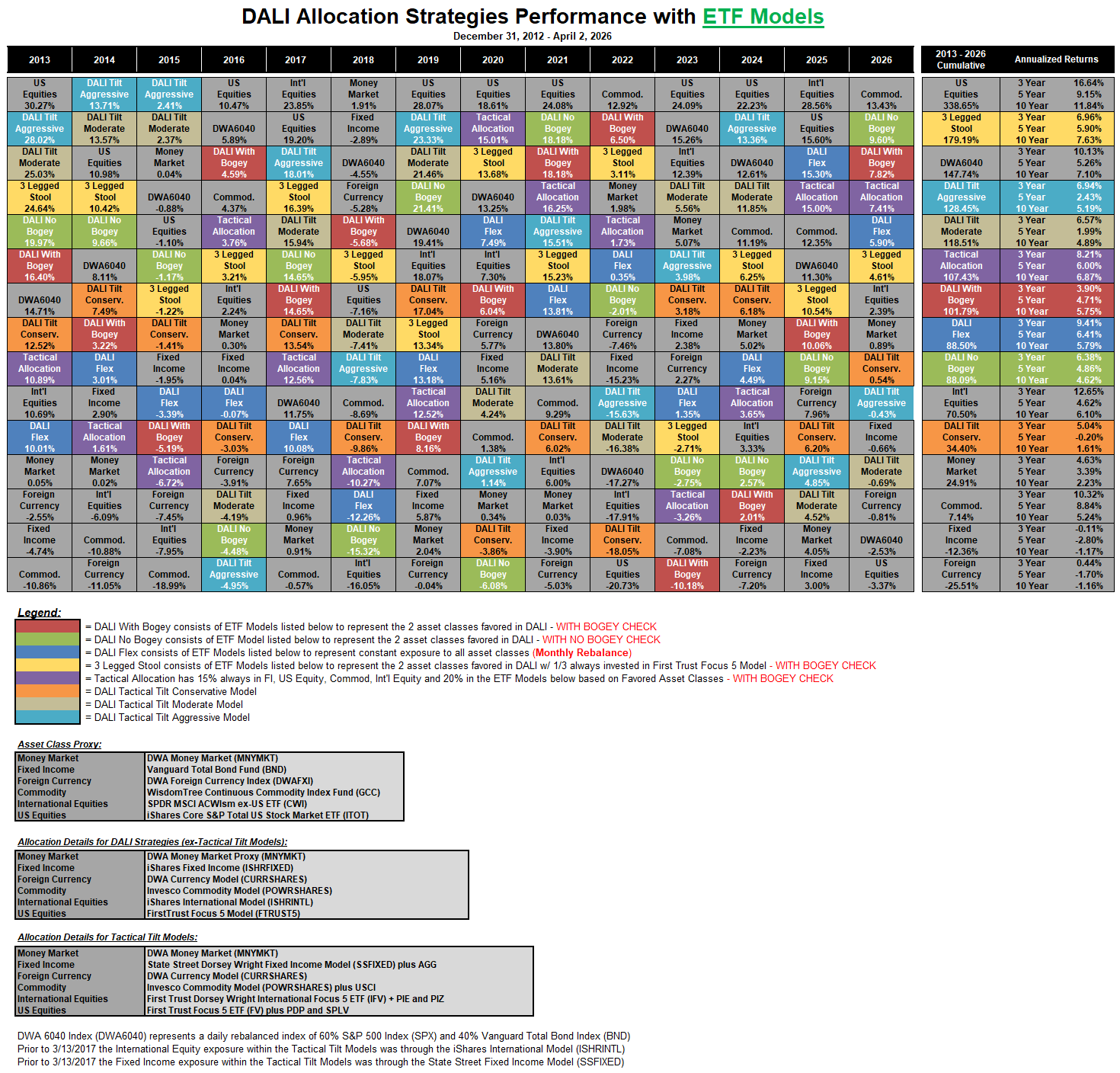
The following performance quilt shows several sample portfolios for the period beginning 12/31/2012. Certain strategies do better than others at different points in time and in different market environments, which is evident in the yearly breakdown. Because we have been in a strong bull market for US equities for most of this period, the strategies that have allowed for the greatest overweight to that asset class ultimately rise to the top in cumulative performance. However, some years, like 2026 so far, saw different asset classes rise to the top of the performance rankings, highlighting the importance of using a tactical approach to shift the allocation when needed.

While certain markets can lend themselves nicely to asset class rotation, it is often the sub-asset class decisions that help generate significant alpha in the portfolio over time. For example, should you be overweighting technology or real estate? Treasuries or high-yield bonds? Emerging or developed markets?
The quilt below displays variations of the DALI Strategies discussed above but adds that additional layer of relative strength analysis to the sub-asset class level. To accomplish this, we have substituted DWA-guided ETF Models' returns for each asset class instead of an index proxy. For example, instead of buying the iShares Core S&P US Total Stock Market ETF (ITOT) for our US Equity exposure, the quilt below assumes an investment in the First Trust Focus Five Model (FTRUST5). As you can see, adding this layer of analysis to your portfolios offers value to asset allocation strategies, with this year's outperformance serving as a great example.