
Five months can seem like the blink of an eye to some investors, but in the world of cryptocurrencies, it can feel like a lifetime. With all significant movement over the last several months, how should we handle Bitcoin?
Five months can seem like the blink of an eye to some investors, but in the world of cryptocurrencies, it can feel like a lifetime. Bitcoin was setting new all-time highs above $125k in October with all the steam in the world behind it. Since then, cryptocurrencies have steadily declined, with Bitcoin moving to a sell signal after falling 50% from its all-time high. However, Bitcoin has since reversed back up into a column of Xs, gaining ~15% from its bottom. With all the movement over the last several months, how should we handle Bitcoin?

While a 50% decline in the stock market would be generationally bad, Bitcoin is no stranger to significant downside. In fact, declines of that magnitude should be closer to the expectation than the exception. To give investors a better idea of that experience, we looked at the probability of Bitcoin declining by certain amounts over different holding periods going back to 2011. While the S&P 500 has never declined by 50% or more within a six-month period since 1950, Bitcoin sees a drawdown of 50% or more in a third of six-month periods. Meanwhile, Bitcoin has experienced an intra-year decline of 20% or more in every single one-year period since 2011. Granted, these numbers are the greatest decline within the period, not the overall return, meaning a period can see large drawdowns and still recover. With our current situation beginning to rebound, should we expect the cryptocurrency market to turn around from here?

There have been six other instances in which BTC fell more than 50% from highs before returning to all-time highs. Once Bitcoin officially moves 50% away from its highs, it tends to do pretty well over the following months. Specifically, it averages a 14% return, which is roughly in line with Bitcoin’s 17.1% gain over the last month. However, things usually take a turn for the worse after the first month. Of those six instances, five of them were lower after a full year, averaging a one-year decline of 19%, which bodes poorly for the upcoming year. That said, if Bitcoin’s outlook has taken a turn for the worse, when could we expect the cryptocurrency to potentially bottom and recover?

Of those six instances in which Bitcoin fell an initial 50%, it averaged a maximum drawdown of 76.6%. Said differently, Bitcoin typically gets cut in half for a second time after the initial 50% decline. Additionally, it took an average of 5.7 months after falling 50% before it reached those respective bottoms. Extrapolating that to our current environment, six months from our initial 50% decline would mean that things could bottom in August of this year, but downside has persisted for more than a year as well. Once Bitcoin finally bottomed out in those instances, it took an average of 15 months to get back to all-time highs. However, it’s also taken as long as 25 months and as short as 4 months.
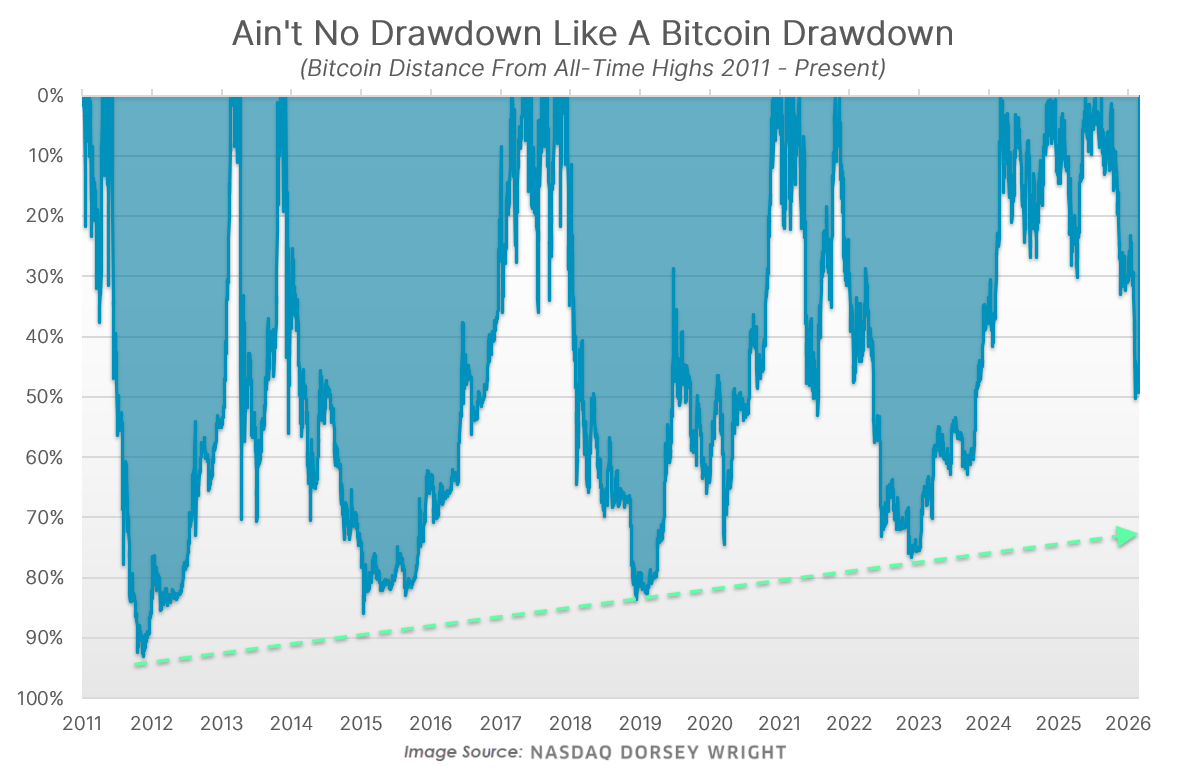
One interesting trend with Bitcoin is that it tends to see a pronounced decline roughly every four years, bottoming in late 2011, 2015, late 2018, and 2022. However, those steeper declines have gradually become less intense over time. For context, Bitcoin was down 76.6% in 2022, but it would’ve needed an additional 70% decline from that point to match 2011’s 93.1% decline. Using some guesswork and continuing that trend, it wouldn’t be surprising to see things bottom out around a drawdown of 70%, which would correspond to a price of around $38k for Bitcoin. Granted, that’s a guess assuming things continue lower, but it also falls roughly in line with the ~75% average drawdown when Bitcoin does fall 50%.
Trying to predict where Bitcoin might go is like attempting to predict the winner of the Super Bowl during the regular season. Recent performance can provide some guidance, but all it takes is a week’s worth of action to change everything. The weight of the evidence suggests that Bitcoin has more room for downside, but investors should watch for signs of improvement if Bitcoin truly has turned a new corner, as cryptocurrencies are known to move quicker than anything else
