
We examine four actionable international equity ETFs.
As we have discussed previously, international equities now rank first in the DALI asset class rankings after overtaking domestic equities earlier this month. For those who use for allocation guidance, this means increasing our exposure to international equities. Unfortunately, much of international equities has been heavily extended for most of 2026 and remains so today – the iShares MSCI Emerging Market ETF (EEM) has a weekly overbought/oversold (OBOS) reading of 129% while the iShares MSCI EAFE ETF (EFA) has a weekly OBOS reading of 114% - which has made it challenging to find an opportune entry points. To help make the process easier, today we have identified four technically strong ETFs that are actionable around current levels.
The iShares MSCI Chile ETF (ECH)
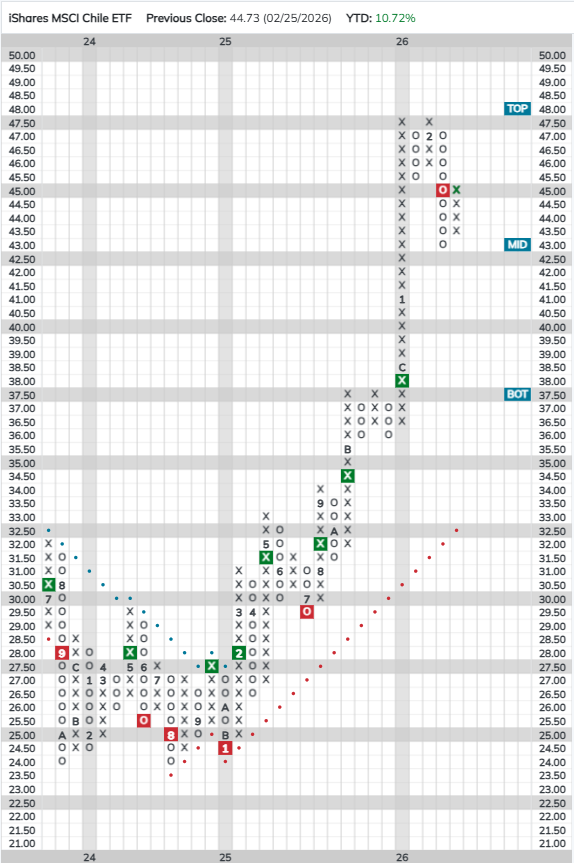
One of the strongest candidates on our list is the iShares MSCI Chile ETF (ECH), which in addition to having a favorable technical picture and trading in actionable territory also has a favorable setup on its default trend chart.
Earlier this month, ECH formed, but didn’t break a double top at $47.50 and then broke a double bottom at $45. In Tuesday’s trading (2/24) ECH reversed up into a column of Xs on its chart, entering the action phase of a potential shakeout pattern, which would be completed with a triple top break at $47.50.
In addition to the recent chart action, ECH has a strong overall technical picture – it currently has a near-perfect 5.72 fund score, which is 1.0 points better than the average for all non-US equity funds, and a positive 1.36 score direction. ECH also currently ranks seventh out of 45 names in the World ETF Matrix.
While much of the international market is heavily overbought, ECH sits well within actionable territory with a weekly OBOS reading of 30%. Short-term investors may consider $42.50 as a potential stop as a move to this level would negate the potential shakeout pattern; beyond this level the next support on ECH’s chart sits at $36. Year-to-date (through 2/25) ECH has gained 10.72% on a price return basis; the fund also carries a 1.8% yield.
The iShares MSCI China Small Cap ETF (ECNS)
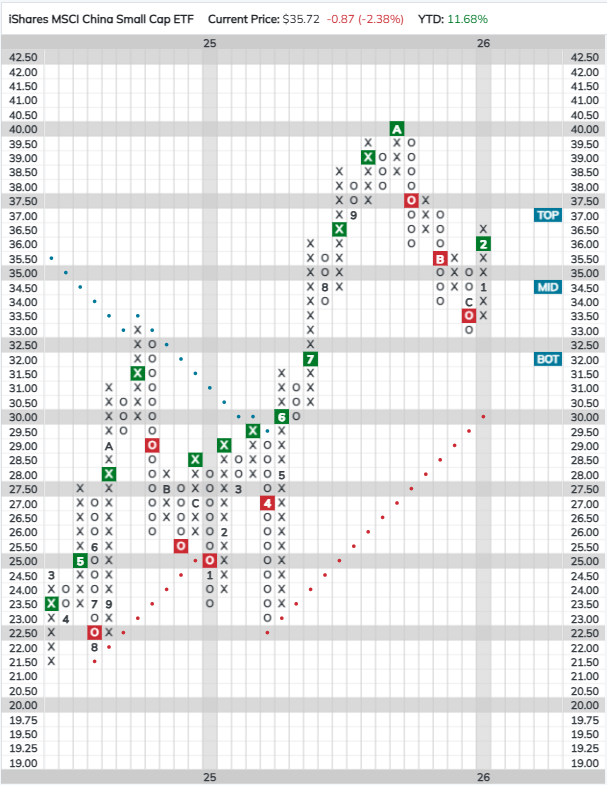
After declining more than 15% and giving three consecutive sell signals from September through December, the ECNS returned to a buy signal earlier this month when it completed a bearish signal reversal at $36.
ECNS currently has a favorable 4.02 fund score, which lags the average for all non-US equity funds, but is better than the average for all China-focused funds. The fund had reached heavily overbought territory, but a pullback on Thursday (2/26) has put ECNS back within actionable territory – as of Thursday afternoon the fund had a weekly OBOS reading of roughly 45%. Initial support can be found at $33, with additional support at $30, where ECNS’s bullish support line also currently sits. Year-to-date, ECNS has gained 11.68% on a price return basis; the fund also carries a 5.7% yield.
The Global X MSCI Greece ETF (GREK)
On its default chart, GREK has given two consecutive buy signals and reached an all-time high in January. The fund has subsequently pulled back to near the middle of its trading band, with a weekly OBOS reading of 11.8%. GREK now sits just above prior resistance, which may act as support; beyond the prior resistance at $70, support can be found at $66 and $62.
GREK currently has a strong 5.51 fund score, which is 0.69 points better than the average for all non-US equity funds; it also ranks sixth in the World ETF Matrix, just ahead of ECH. Year-to-date, GREK has gained 8.5% on a price return basis and also carries a 3.1% yield.

The iShares MSCI Ireland ETF (EIRL)
On its default chart, EIRL has given four consecutive buy signals, most recently completing a bullish catapult in November of last year. The fund reached a new all-time high earlier this month before pulling back to just above prior resistance and currently sits near the middle of its trading band, putting in well within actionable territory.
EIRL has a strong 4.92 fund score and has been on a market RS buy signal since 2023 and trading in a positive trend since 2022. Year-to-date, EIRL is flat on a price return basis and carries a 2.7% yield.
International equities have continued to outperform their domestic counterparts in 2026, but the strong performance has pushed broad international funds into heavily extended territory. We often see stocks and funds in strong uptrends become overbought and continue higher. But, for those who prefer less-extended options all of the funds highlighted above are viable candidates.

