
Momentum strategies continue to hold strong as we move into Q4, but have seen some slowdowns.
From a year-to-date perspective, momentum strategies remain on strong footing against major benchmarks. However, this headline number only tells half the story, as Q3 was particularly rocky for trend followers as some rotation occurred across sector leadership. Large cap equites maintained a bit more of a cushion than their small cap counterparts, seeing the Invesco Dorsey Wright Momentum ETF (PDP) continue to outpace the Russell 1000 ETF benchmark (IWB) through 9/29. Small cap momentum struggled a bit more, seeing the Invesco Dorsey Wright Small Cap Momentum ETF (DWAS) falling roughly in line with benchmark IWM after outperforming through the first half of the year.
The performance table below compares the price return of the Invesco Dorsey Wright Momentum ETF (PDP) and the Invesco Dorsey Wright SmallCap Momentum ETF (DWAS) to their respective benchmarks through Q3, while the two bottom tables zoom out to broader, calendar year performance from 2001 to 2026 (through 9/29/2026).

Our approach toward momentum through relative strength analysis looks to capitalize on consistent trends across the market. Changing trends cause the portfolios to readjust to maintain exposure to the strongest areas. Underperformance is typical during those environments as areas that had demonstrated relative strength fall in our rankings. The most important step in our approach comes next – those areas that have declined in strength are sold to make room for the new leaders. Any investment process is going to produce a portfolio of winners and losers. Relative strength analysis gives us a systematic way to cull the losers and constantly push the portfolio toward the strongest areas of the market.
In the most recent quarter, we saw 55 changes (out of 100 holdings) in PDP and 123 changes (out of 200 holdings) in DWAS, repositioning both portfolios toward areas of leadership as we enter the second quarter. Both portfolios saw roughly equal amounts of turnover as they did last quarter.
Below you'll find an update about the specific changes made in both strategies with the most recent index reconstitution. Keep in mind that removed positions likely no longer maintain characteristics of superior relative strength; meanwhile, additions have improved to a place of leadership and could be ideas to consider.
Invesco Dorsey Wright Momentum ETF (PDP)
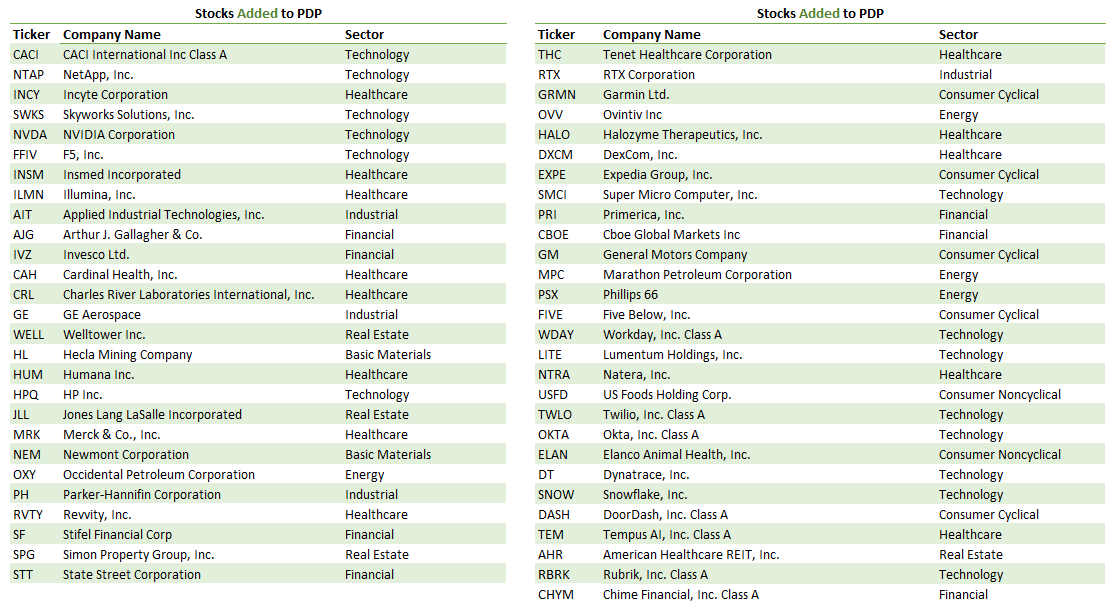
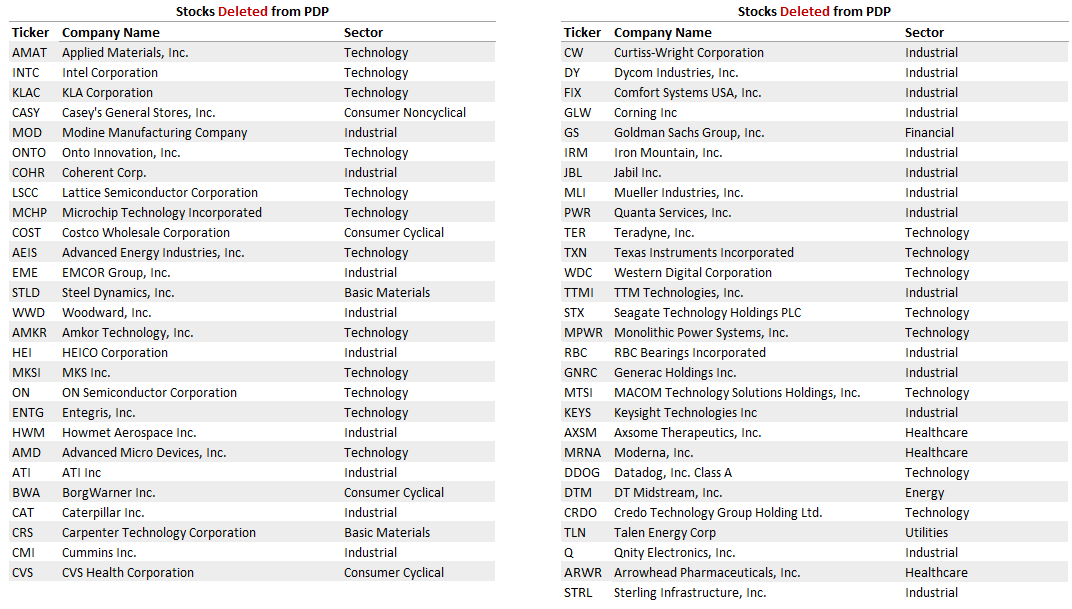
The stock-selection process behind the Invesco Dorsey Wright Momentum ETF (PDP) is simple yet robust. Every quarter, we apply the relative strength process to compare approximately 1,000 large- and mid-cap US stocks and select the strongest 100 names. The quarterly reconstitution process's goal is to weed out the weak names and realign the portfolio toward strength. As mentioned before, with this most recent reconstitution and rebalance, we removed 55 stocks and added 55 new stocks, which we've compiled in the tables below. Several observations:
- Technology and healthcare saw the most improvement in Q2, accounting for over half of the of the new additions.
- Industrials saw the most removals from the portfolio, speaking for just under 50% of total removals. Interestingly enough, this follows up last quarter which saw the sector stand for the most amount of removals.
- Additions were largely focused on healthcare and technology. Financials and rounded out the top three and four as each brough a handful of newcomers.
- While it stood for a large minority of the additions, technology also saw a wide array of removals as well, speaking to the magnitude of rotation within the sector and markets as a whole.
Invesco Dorsey Wright SmallCap Momentum ETF (DWAS)
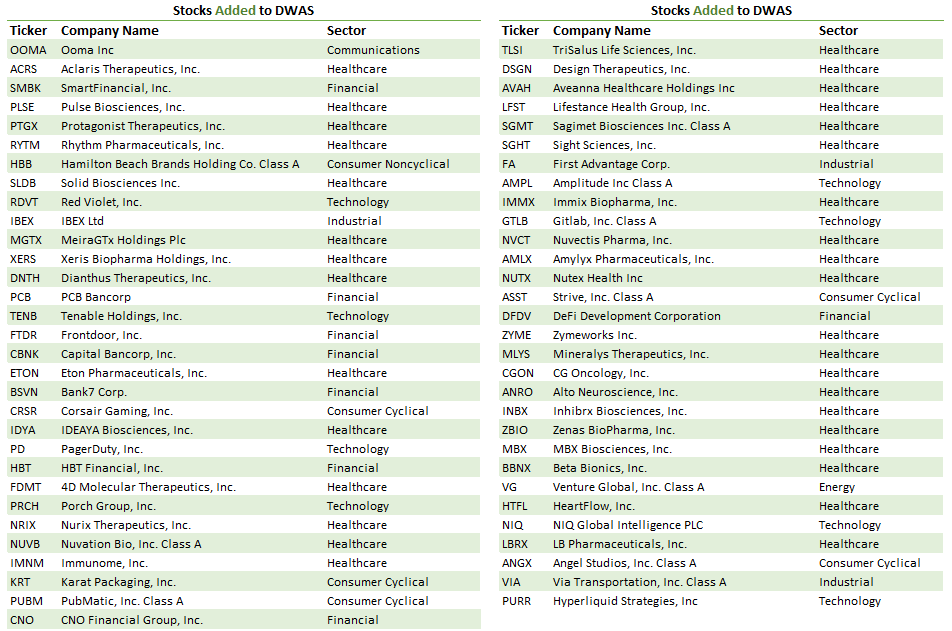
The stock-selection process used in DWAS is like PDP. Every quarter, we apply the relative strength process to compare approximately 2,000 US-listed small-cap stocks and select the strongest 200 names. With this most recent reconstitution and rebalance we pushed the portfolio towards strength by removing 123 stocks and adding 123 new stocks, which we've outlined in the table below. However, and perhaps unique to DWAS, not all stocks that were removed are technically weak. We have received this question in the past, so we want to address it here.
One reason for these removals is due to stocks exceeding the market cap filter. High-momentum stocks should, ideally, increase in market cap which means that sometimes a name will exceed the small-cap maximum at the end of a quarter. This is not the norm, but worth keeping in mind when reviewing the changes. Several takeaways:
- Similar to last quarter, healthcare saw the most additions to the portfolio as we move into Q3. The sector represents roughly 40% of newcomers as biotechnology names continued to flex their muscles.
- Financials rounds out to the top two of our additions, but only represents ~13% of new names. Point being, rotation has been quite focused towards healthcare over the course of the last quarter.
- Similar to the large cap space, industrial options also accounted for the most amounts of removals from the portfolio. The group has fallen within the NDW rankings (DALI, ACGS, etc.) and its strength is quickly fading as we close out 2026.

Disclosures:
This article is intended for Financial Professional Use Only.
Management and other expenses can have a material impact on performance when compounded over time. Past performance, hypothetical or actual, does not guarantee future results. In all securities trading there is a potential for loss as well as profit. It should not be assumed that recommendations made in the future will be profitable or will equal the performance as shown.
Click here for more information from Invesco on the Invesco DWA Momentum ETF (PDP): https://www.invesco.com/us/financial-products/etfs/product-detail?audienceType=Investor&ticker=PDP
Click here for more information from Invesco on the Invesco DWA SmallCap Momentum ETF (DWAS): https://www.invesco.com/us/financial-products/etfs/product-detail?audienceType=Investor&productId=ETF-DWAS
Dorsey, Wright & Associates, LLC is owned by Nasdaq, Inc. and we have affiliates who also provide financial services, research, information, and act as Brokers/Dealers to a wide variety of clients. Our affiliates use the information we create to create indexes, which are then used to create Exchange Traded Funds. These things create a potential conflict of interest in that we may have an incentive to promote or use the products and services of our affiliates and business partners. A number of Dorsey Wright representatives are registered with and hold securities licenses with the affiliate broker-dealers. In this capacity, they assist with the marketing and distribution of Exchange Traded Products.
