
When entering a battle, an army needs strength from both its generals and soldiers to secure victory. Given the importance of the two groups, where do the generals (mega caps) and soldiers (average stocks) stand as we enter the 2nd half of 2026?
When entering a battle, an army needs strength from both its generals and soldiers to secure victory. Generals are helpless when abandoned by their troops while soldiers are lost without the direction of their general. Just like a battlefield, the stock market requires a delicate balance between the strength of its largest and average names to move higher. An ideal bull market features strong performances from both the generals and soldiers. While markets can rise at the hand of just one of those groups, they do so more easily when both contribute to the upside. Given the importance of the two groups, where do the generals and soldiers stand as we enter the second half of 2026?
The past few years have brought greater focus on the relationship between mega cap stocks serving as generals and the average stocks soldiering behind them. The generals have been leading the battlefield since 2023, with stocks like the Magnificent Seven carrying the market higher while the soldiers took a backseat. That’s not to say the soldiers haven’t moved higher, only that the magnitude of gains from the generals has been stronger. Over the last three years, the Invesco S&P 500 Equal Weight ETF (RSP) is up 44.3%, which is a solid period for average stocks. However, the fifty largest companies have done significantly better than that. The Invesco S&P 500 Top 50 ETF (XLG) is up 74.5%, meaning that the generals have outperformed the soldiers by more than 30%. The only time that mega caps held such a wide lead over the average stock has been the 2020s. That said, the spread between the two groups has narrowed significantly over the last several months. At their peak in November, the generals were outperforming the soldiers by 85% over the past three years, so the lead in favor of mega cap stocks has shrunk by more than 50% since then.

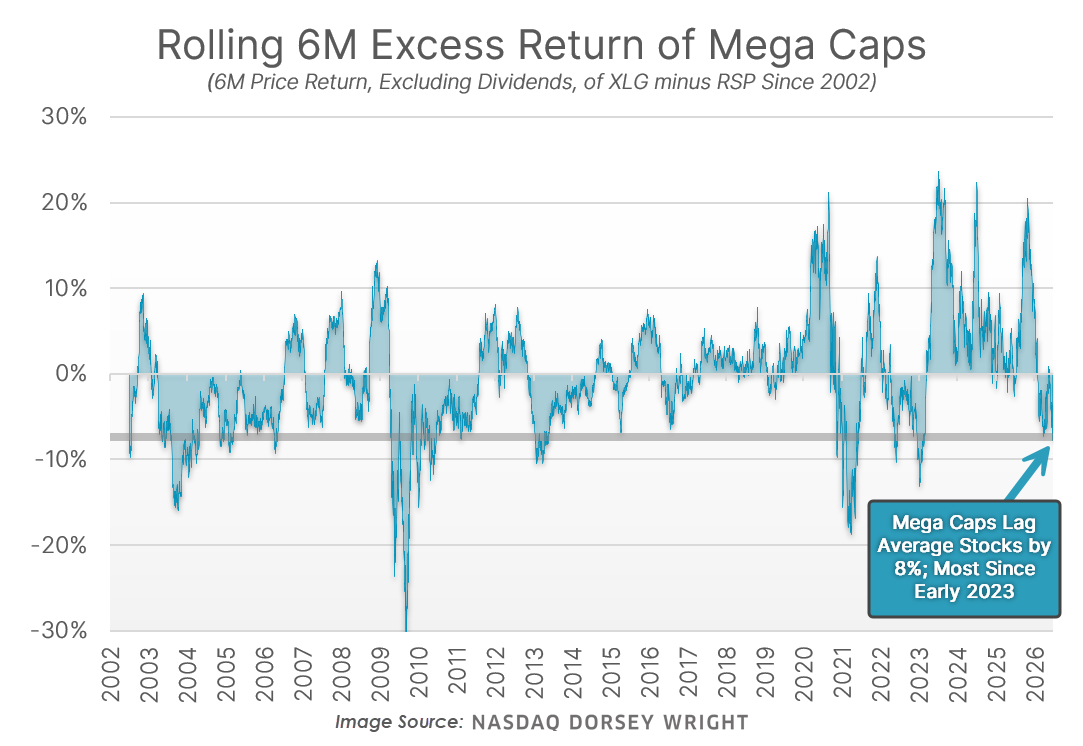
To highlight just how much the market has recently diverged from the last several years, we looked at just the last six months as well. Over that span, RSP has gained 8.2%, whereas XLG has gained a meager 0.4%. Said plainly, the soldiers are beating the generals by 7.8% this year, which is the widest margin in favor of the average stock since early 2023. Some investors view cap weight outperformance as potential for greater market fragility, so with the soldiers doing more heavy lifting, it could be a positive sign for the market. Additionally, preferences towards either the generals or soldiers can last for an extended period, as was the case for the soldiers in the 2000s and much of the 2010s. Investors should continue to watch whether soldiers can sustain their recent outperformance versus the mega cap giants that led the market over the last several years.
Another measure of whether the soldiers are entering or leaving the battlefield is the bullish percent indicator (^BPSPX), which tracks the percentage of stocks trading on a buy signal. Periods where indices and participation move in opposite directions are typically referred to as “bearish divergences,” signaling increased fragility due to the market’s dependence on just a few names. Unfortunately, the bullish percent and the S&P 500 have been trending in opposite directions since the tail end of last year. Over the last year, SPX has gained more than 20%, but BPSPX has fallen from 68% to 52%, as seen in the graph below. The last two times the market saw a divergence like this were 2021 and late 2024, both of which preceded some downside in the following year. That said, there isn’t too much cause for concern just yet.

Looking at the traditional BPSPX chart, our current levels of 52% indicate that most stocks are trading on a buy signal and participating in upside. While it has declined over the last year, we would expect the bullish percent to fall from 70% given the difficulty of maintaining such a high reading. The indicator was also approaching low levels around 30% in March as the market declined but has since rebounded. So, while the market and participation have moved in opposite directions over the last year, the two have still followed one another as rallies occurred. For now, current levels are still healthy, and investors should only grow cautious if the indicator has an extended stay below 50% without approaching washed out levels under 30%.

