
The Dow crossed above 50,000 for the first time in its history on February 6th, 2026.
A new car. A European getaway. A luxury watch. Lots of things come to mind when you talk about $50,000. For many clients, that sum is much more than pocket change and is a major psychological landmark along our financial journey. While not measured specifically in dollars, the Dow Jones Industrial Average notched its own respective landmark over the last week… crossing above 50,000 for the first time in its history on February 6th, 2026. While updates of our 1,000 point landmark piece are much less frequent than they were just a few years ago, notable landmarks like 50,000 give us an opportunity to look back at where we have come from in an effort to predict where we might be going as we move through 2026.
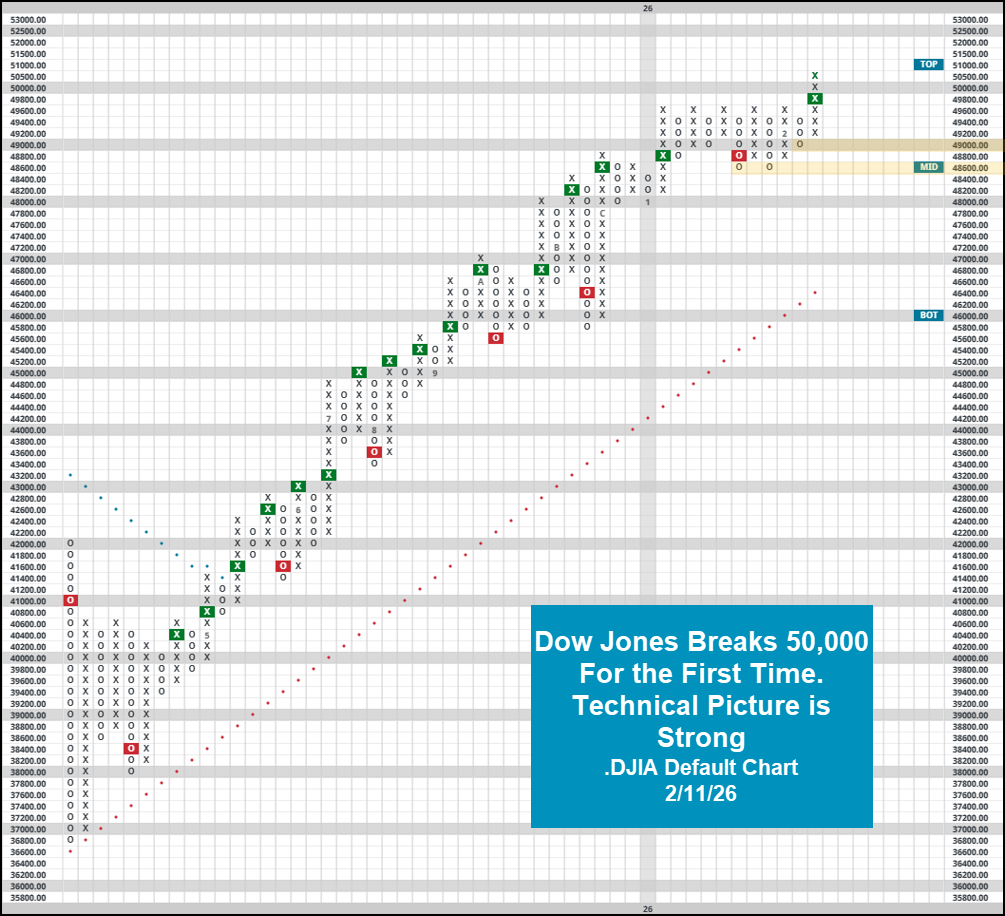
Before diving into the table, we will provide a brief technical comment on the Dow Jones as of 2/11. While other domestic benchmarks have struggled this year, the Dow has been able to put together a rather constructive opening to 2026. .DJIA has advanced roughly 4% as of the time of this writing, edging out the likes of NDX or SPX which have struggled as growth names have pulled back. This is partially due in part to the overall weighting methodology differences between the indices- the Dow is price weighted while others are market cap weighted. This means that the likes of AMZN, AAPL or NVDA have less of an overall impact on movement than higher priced names like CAT, GS or AMGN. This difference can help in some markets and hurt in others, but less overall reliance on big technology names have helped the index so far this year. This is quite evident on the default chart for .DJIA. After struggling to break through 49,600 a total of five times to open the year, it finally broke a quintuple top to crest 50,000 for the first time ever to start February. With support littered between 48,600 and 49,000, the technical picture is strong and improving.
With that said, we can journey into an analysis of other notable instances during which the Dow broke past important “landmarks.” Before going further, it is worth defining what we mean as “notable”. At this point, a 1,000 point move represents a mere 2% move off current levels… a metric that could seemingly come at any point in today’s fast moving environment. With this in mind, we adjusted our table from showcasing every 1,000 point move to those which represented a ~5%-10% move from the previous landmark, starting from 10,000. Said more plainly, the 3,000 point advance from 47,000 to 50,000 is the roughly same mathematical gain as moving from 16,000 to 17,000 back In 2013. The point of this is to observe moves on a more level playing field rather than hyperfocus on a move that could happen in the course of a trading week. Some interesting, high level statistics:
- It took just 105 days for .DJIA to move from 47,000 to 50,000 from October 24th 2025 to February 6th 2026. This marks the quickest move between “significant” breakpoints since the 69 day break from 31,000 to 33,000.
- This 105-day metric is also significantly quicker than the “average” timeline throughout longer timeframes. The typical duration between notable breakouts sits just under 650 days (do note this includes significantly longer stretches from the early 1970’s into 1990’s).
- The 105-day stretch is also much quicker than looking at other more comparable breakpoint rallies metrics. The average duration between landmarks between 10,000 & 50,000 sits at 462 days, accelerating to just 187 days when looking at the four instances ranging from 40,000-50,000. All this to say, market movement seems to continue to speed up in a post-Covid world.
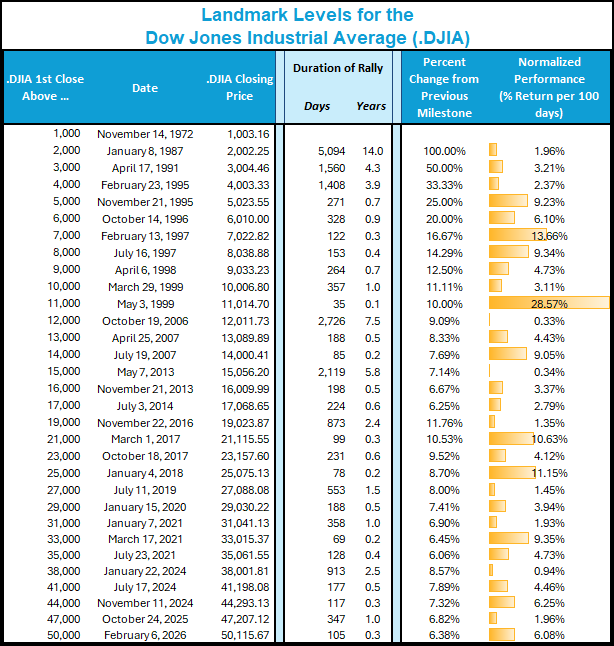
Judging by these metrics alone, the next 3,000-point move (~6% gain from current levels) would come by August 11th, 2026. While there is certainly no guarantee that such an advance is coming down the pipeline, the overall technical posture remains strong for the Dow… and domestic equities in general despite some growing signs of changing leadership. As always, keep an eye on the charts in the event of further shifts worth monitoring.
