
After having been among the better performing sectors during the first three quarters of 2025, utilities have had their share of fits and starts during Q4 2025 and kicking off 2026.
After having been among the better performing sectors during the first three quarters of 2025, utilities have had their share of fits and starts during Q4 2025 and kicking off 2026. In recent years, utilities have been a “pick and axes” play of sorts for the AI theme as utility providers have announced and planned projects around supplying power to data centers. But as with the AI theme, investors are beginning to find out which companies are moving forward with plans as well as those who simply were trying to drum up attention.
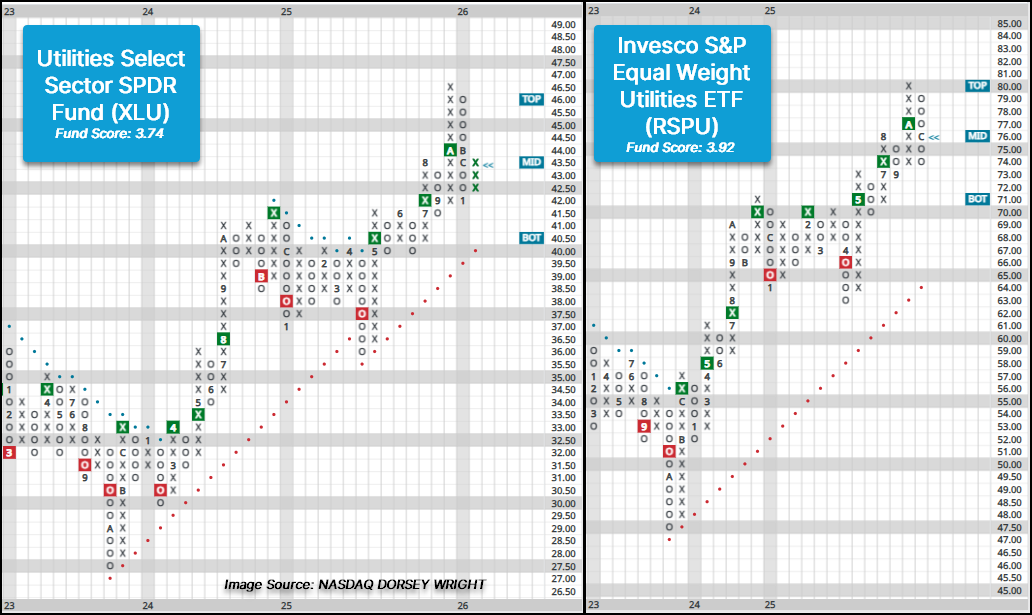
After being up 15% and 16% through the first three quarters in 2025, the Utilities Select Sector SPDR Fund (XLU) and Invesco S&P Utilities Equal Weight ETF (RSPU) are basically flat in since 9/30/2025 thanks to a stellar rally on Thursday (1/15). While both funds still maintain a positive trend and buy signals, utilities have lagged other notable sectors like materials and energy, which have led both sector ETF lineups to kick off 2026.
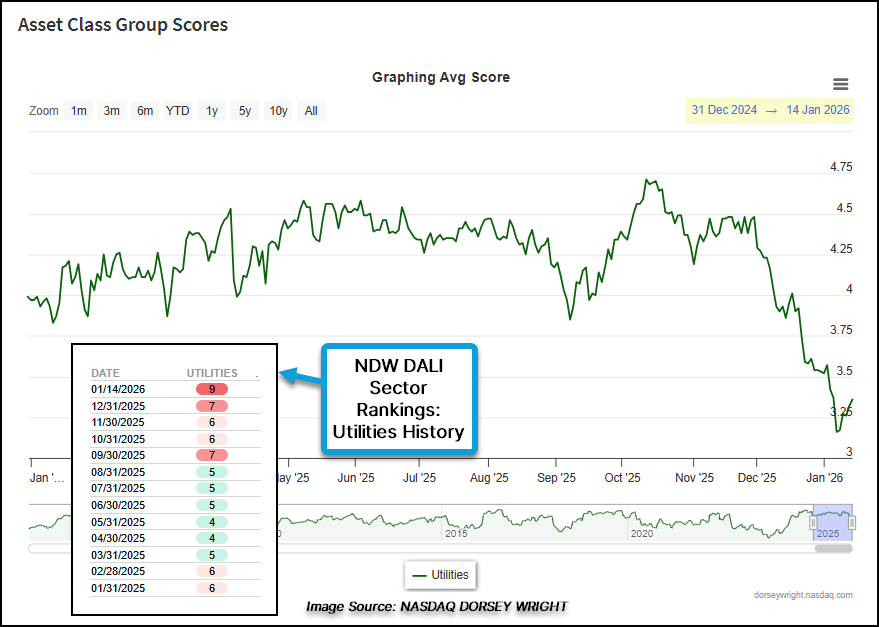
Looking at the market relative strength chart for both ETFs, XLU reversed down in late December, while last week’s action brought RSPU back into Os. Each fund maintains a positive trend and long-term market RS buy signal, which helps sustain acceptable fund scores north of 3. But, as can be seen on the NDW DALI Asset Class Rankings and Asset Class Group Scores page, near-term negative RS has impacted the technical picture for the broader sector.
After reaching as high as fourth in the middle of 2025, the sector slowly worked its way down to the rankings during Q4 before ultimately falling down to ninth to kick off 2026, marking the sector’s lowest ranking since July 2024. Meanwhile, on the Asset Class Group Scores page, utilities scored above 4.0 (out of 6) for most of 2025. But the sector has recently fallen to test the acceptable 3.0 group score threshold, a position it has maintained since mid-2024.
While relative weakness versus sector counterparts can be seen on the DALI and Asset Class Group Scores page, intermediate- and long-term participation within the sector has also taken a hit. After the bullish percent for the broader sector (^BPECUTILITY) reached a historically elevated ready of 76% back in October, the chart reversed in early November and has fallen to 60%. In a somewhat similar fashion, the long-term positive trend indicator for the sector (^PTECUTILITY) reached its highest chart level in five years at 68% before reversing down to Os in early December. While both indicators suggest that roughly six out of every 10 stocks within the sector still maintain a buy signal and positive trend, many have lagged relative to their sector counterparts in recent months.

Although there are a number of stock examples that speak to the relative weakness within the broader sector, a prime example is Constellation Energy Corporation (CEG). Prior to last week’s action, CEG had been at least a 3 technical attribute stock since May 2025. Along with a shift into a negative trend on its default point and figure chart on January 6th, CEG's market relative strength chart reversed into a column of Os after having been in Xs since April last year. Further signs of relative weakness for CEG can be seen in the Electric Utilities sector matrix, where the stock has fallen into the bottom quintile, along with its peer relative strength chart residing within one box of reversing into Os. Though CEG did return to a buy signal during Thursday’s trading (1/15), Friday’s intraday action brought the stock back to a sell signal and violated support in the lower $300 range that had been in place since November. Support for CEG now lies at $296, the September 2025 chart low, while additional can be found in the $280 range.
While there are broad sector funds along with individual stocks that maintain acceptable technical pictures for the time being, some of the positive evidence for the broader sector has turned negative as it has lagged other sectors.

