The Large Cap Core Model presents a diverse list of names that has generated consistent relative strength.
The phrase “stock picker’s market” seems to be picking up steam across the financial media lexicon. Goldman Sachs released an article in February titled “US Equities are Ripe for Stock Pickers.” Fast forward to July and Morgan Stanley put out a piece of their own titled “It’s a Stock Picker’s Market.” Of course, these are just two examples in a sea of market calls. Calls like this often come from banks that are simultaneously trying to pitch you new actively managed products to take advantage of their stock pickers.
With that in mind, we are reminded of a Portfolio Management Perspective article from January 2016, titled, "If You're Going to Be Active, Be Systematic." The article, had a quote from Michael Batnick of The Irrelevant Investor, which stated, "When considering active strategies, it’s important for us that we’re not relying on anyone’s intuition, expertise, or mental or emotional well-being. We don’t want our PMs speaking with management, doing channel checks, or backing out the cash. We want them to follow their models with as little interference as humanly possible" (Michael Batnick).
That's exactly what the NDW methodology and guided models provide - a systematic, unemotional process that allows you to run your portfolios with "as little interference as humanly possible." We have a variety of different stock models available on the research platform, spanning various sectors and factors. One of the broadest approaches is our Large Cap Core Stock Model, which was launched back in May 2020. A general overview of the model’s structure and recent performance can be found below:
Model Structure
- The NDW Large Cap Core Stock Model was designed to be a core allocation (as the name suggests) for investors seeking a systematic way to invest in individual US equities.
- The Model begins with 500 large-cap US equities, stacks each name up against one another according to relative strength (RS), and seeks to hold the top 30 names from that RS ranking.
- If a name falls into the bottom two-thirds of the RS rankings at the end-of-month evaluation, it is sold and replaced by the next highest ranked stock not already held by the model.
- We also add a single-sector exposure cap of 40% toward any one sector.
- More specific information can be found in the Model Info File
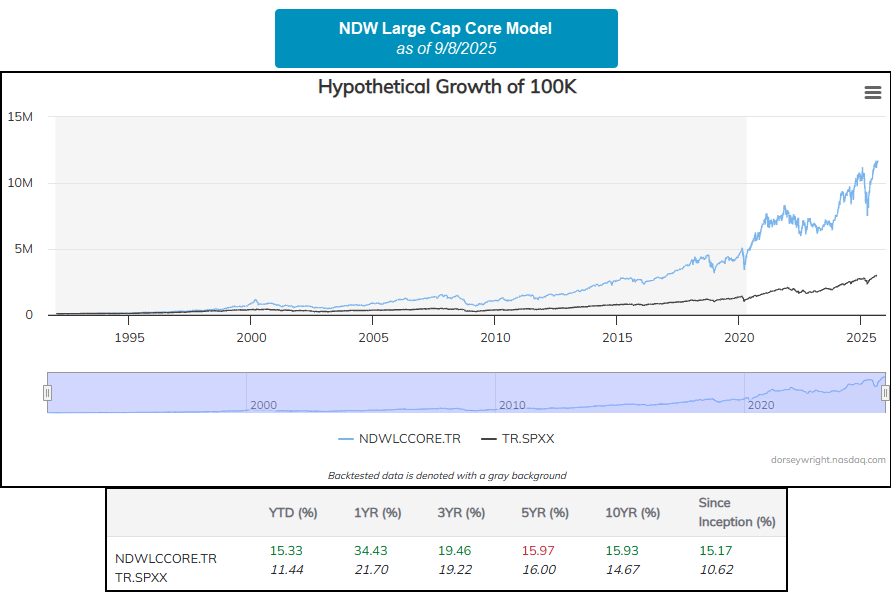
As you can see from the recent returns, the systematic approach of the model has been beneficial. However, it is important to keep in mind that not every stock “picked” by the model is going to be a winner every time. Instead, the overall model seeks to be a winner over time. Some names will certainly be big winners, like DoorDash, Inc. (DASH), which has been a holding in the portfolio since August 31, 2023, longer than any of the other positions. Over that time, DASH returned over 197% (through 9/8), compared to the 44% gain of the S&P 500 Index (SPX). Other names will not be as additive, but that is why we maintain a strict sell discipline. Losers are automatically dropped from the portfolio, allowing the model to rotate into a new area of strength.
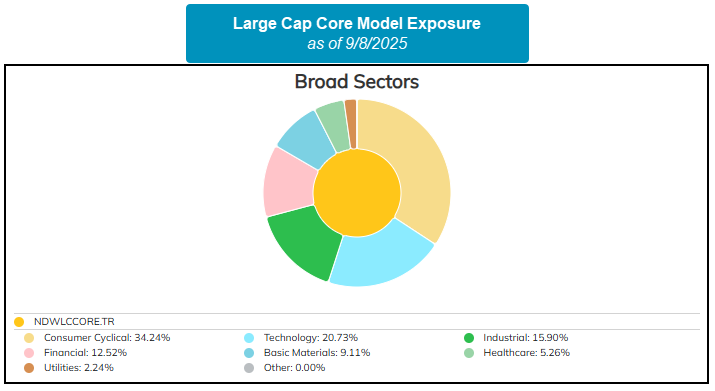
The 30 holdings currently represent seven of the 11 broad sectors. Consumer cyclicals make up the largest allocation at just over 34%, followed by technology at about 20% of the portfolio. The current holdings show no exposure toward real estate, consumer staples, energy, or communication services.
There are a variety of ways to implement a systematic process throughout the NDW research platform. Whether it be the security screener, broad rankings, buy lists, or models – different approaches work best for different investors. The important thing is implementing a process and sticking with it. Those looking to stay up to date on trades within the Large Cap Core Model can set alerts through our Model Portfolios page, allowing the system to notify you have any changes.