
We look at mitigating risk while retaining upside with a modified collar strategy.
Over the last two weeks, we have discussed heightened uncertainty in the market, from indicator divergences to a potential uptick in volatility. Geopolitical and economic worries have added to the uneasiness. At the same time, the relative strength picture for domestic equities is still largely positive. This is a tricky problem for those who are concerned about the uncertainty but are wary of significantly altering their exposure or paying for puts in market that has been relatively strong.
One way to control risk while preserving upside and not paying significant option premium is through options with asymmetric risk/reward profiles. Asymmetric risk-reward in this context means that long-dated call options on these stocks are expensive relative to put options at the same expiration. This allows us to buy the stock, purchase a put for downside protection, and finance the put premium by selling a call that is further out of the money, providing us with upside (from the current price of the stock to the strike of the call option) that is in some cases more than three times the potential downside (from the current price of the underlying stock to the strike of the put option). This is similar to a traditional collar strategy, but instead of the call and put strikes being equidistant to the stock price, we are looking only for stocks that offer more upside than downside.
You may wonder “Why do I need to use options? I could just buy the stock and set a stop at the put strike and not have my upside capped by selling a call.” That is certainly an alternative. However, what the put option affords you is the freedom to let the stock decline below the put strike (and hopefully recover) without worrying about having to realize that loss. Should the stock experience a large decline, it also affords you the opportunity to own it at a significant discount to its current price. For example, if you entered into the NVDA position on our list and the stock subsequently declined to $140, you could sell your put, collect $20 (assuming a sale price at the intrinsic value of the option - $160 minus $140), and own the stock with a cost basis of around $152.
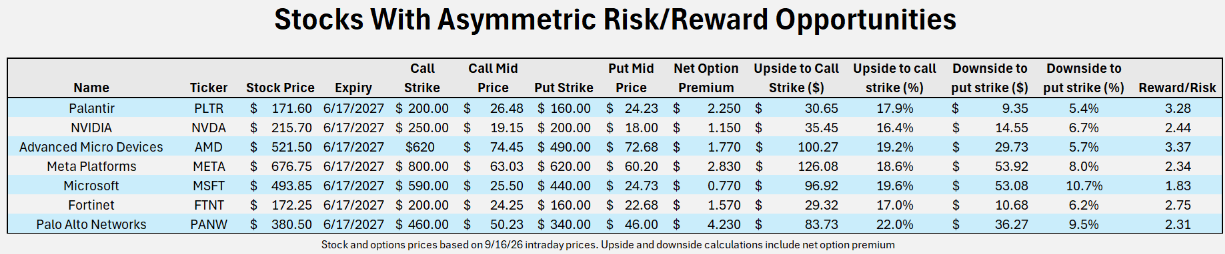
These modified collars can also be used to construct a “buffered” or defined outcome portfolio. But, unlike using a buffered ETF, you avoid the fees and can significantly improve your reward-to-risk ratio.
These are just a few examples of stocks with options that have asymmetric payoffs, but there are other names out there that offer similar risk-to-reward profiles. They can typically be found in stocks that attract a lot of speculative option investment, like PLTR & NVDA. Also, these are not the only expirations and strikes at which these stocks may offer asymmetric opportunities. If you conclude the downside risk is too great, you may be able to find a better fit by raising the put strike and lowering the call strike. As a general rule though, as the expirations of the options get closer to the present and the strikes get closer to being in the money, the reward-to-risk profile tends to deteriorate.
The type of asymmetric opportunities we've highlighted here are not ideal for filling out an entire equity allocation. There simply aren't that many of them out there, and due to the capped upside, they are likely to underperform in a strong bull market. However, they can be quite useful for taking targeted positions. As mentioned above, they can also be used to create a “buffered” portfolio instead of relying on off-the-shelf products that have less attractive risk-to-reward ratios. They are also a way that you can differentiate yourself, as they add a level of sophistication to your client's portfolio that many of your competitors don't offer.
