
Warren Buffett once said, “Be fearful when others are greedy and greedy when others are fearful.” Today, we look at the fear and greed in the market.
People have strong opinions on everything these days, from politics to pineapple on pizza, and the stock market is no different. For many of us in the industry, questions from family, friends, and clients about the “AI bubble,” SpaceX, or the economy seem inescapable. So, if it feels like everyone has a take on the stock market, there’s more than just your gut feeling to support that notion.
One way to evaluate sentiment is to compare how many investors think the market will rise versus how many think it will fall. The AAII sentiment survey does precisely that, asking investors whether they expect the market to rise, fall, or remain flat over the next six months. Historically, 31% of respondents to AAII’s survey have held a neutral outlook on the market, but there appears to be a new normal. Over the last two years, only four of 104 weeks have seen an average neutrality level of 31% or higher. It’s not like the markets have been particularly extreme during that span, either. Volatility has been relatively normal, as the VIX has averaged approximately 18.5, which is below the long-term average. The S&P 500 has been an average of 2.2% away from all-time highs, well below the normal average of 10.4% since 1987. Despite that, investors continue to have opinions about the market, with a plurality of those being negative.

The AAII Survey Bull-Bear Spread (AAIISPREAD) subtracts the percentage of bearish respondents from the percentage of bullish respondents to gauge overall sentiment. A positive reading indicates more bulls than bears, while a negative reading suggests the opposite. Currently, the AAII spread of -11% indicates a bearish, though not overly extreme, stance on the market. The good news is that, historically, investors are poor at predicting the direction that stock prices will move. In fact, when the sentiment spread is between -20% and -10%, the forward returns for the S&P 500 have been stronger than average from one week to two years out.

Additionally, the AAII Spread has been negative for six consecutive weeks, which is a rare occurrence. In fact, a streak of six weeks or longer occurs around once every 17 months, placing recent action in highly unusual territory. Thankfully, streaks of negative sentiment have historically been associated with stronger returns. The S&P 500 has averaged a 13.6% one-year return across the other 27 instances where the AAII spread achieved its sixth consecutive negative week. If the negative streak were to continue, it would be an even more bullish signal, as longer streaks have been associated with even stronger returns, albeit on fewer occasions.
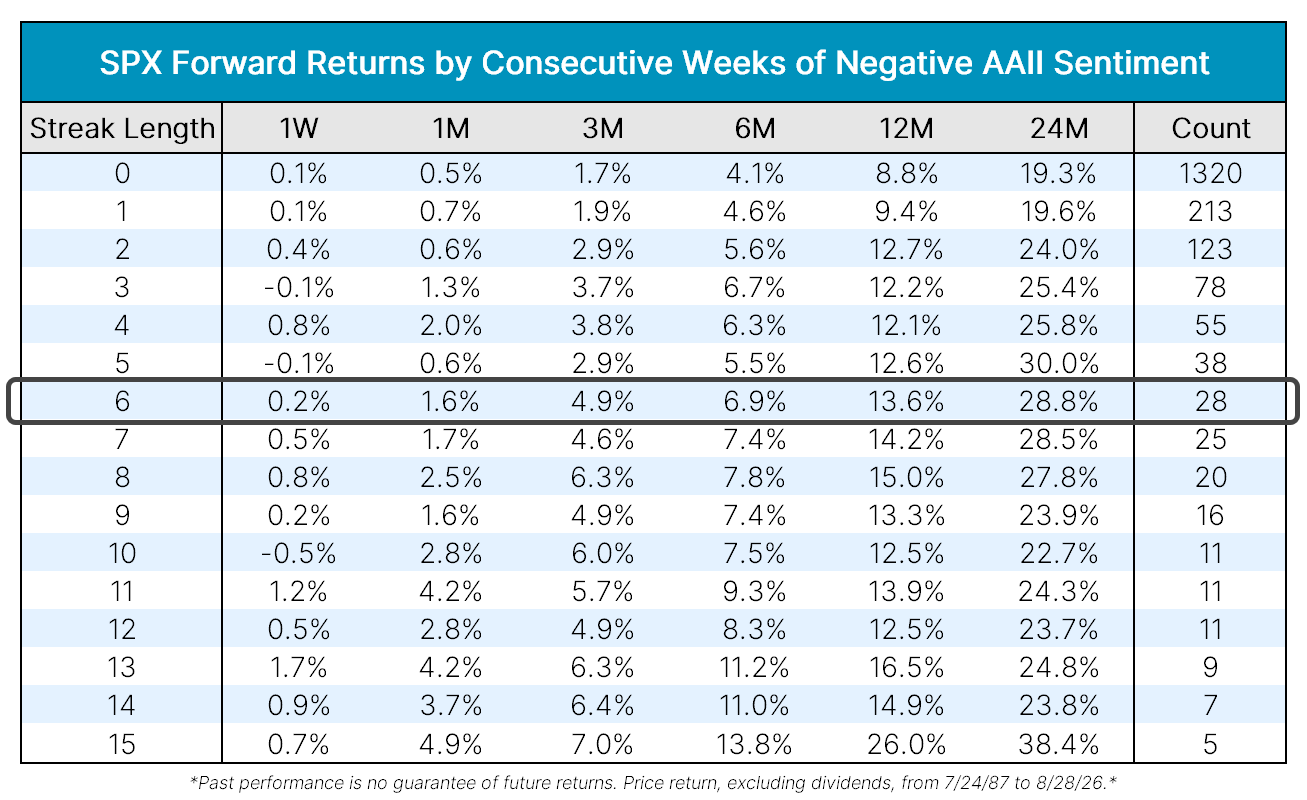
That said, there have also been negative streaks of 15, 9, and 7 weeks since the start of 2025, highlighting how abnormally cynical investors have been. The average AAII Spread reading over the last two years is 2.4%, which is more bearish than 87% of two-year stretches going back to 1987. While that alone is notable, the negative sentiment is even more significant given the strength of the market over that period. There’s a common market adage that says, “sentiment follows price.” Generally, trailing two-year sentiment tends to follow the trailing two-year return of the S&P 500, but recent years appear to be an exception to the rule, with sentiment remaining abnormally subdued despite the S&P 500 gaining a cumulative 38% (8/28/24 - 8/28/26).

There have been only a handful of occasions where the market was bearish on average over the prior two years despite the S&P 500 gaining more than 20%. Looking at those six other instances, the S&P 500 averaged a one-year return of 16.2% and a two-year return of 27%, underscoring how skepticism during previous bull markets (and 2022) served as a positive sign going forward. Warren Buffett once said, “Be fearful when others are greedy and greedy when others are fearful.” With the market remaining in fearful territory, it wouldn’t be surprising to see investors eventually become greedier, which could serve as a potential catalyst for further upside.

