
Is the recent rebound of Bitcoin a sign of better times ahead, or should we be cautious of downside resuming?
When it comes to purely speculative assets like Bitcoin, panic among investors has historically been more likely to beget further panic. Once the asset began to decline in October of last year, it did so rapidly, declining more than 50% from its highs within months. While the sharp movement of Bitcoin is easily its biggest flaw, it can also serve as its greatest strength. Downside can occur rapidly, but so too can upside, and Bitcoin’s positive action over the past week would be near-impossible for any other asset. Bitcoin rose 21% within three days, rising over 5% each day, to reach its highest levels since May, marking its highest three-day return since July 2021. Euphoric conditions can see other investors rally behind the cryptocurrency for fear of missing out on upside—often for longer than just a week. As a result, is the recent rebound of Bitcoin a sign of better times ahead, or should we be cautious of downside resuming?

Just like when analyzing participation indicators, comparing the near-term indicators for Bitcoin with intermediate- to long-term ones can help us build a better understanding of its strength. Moving averages (MAs) are the foundation of several of our technical indicators, but they can also help evaluate individual securities in select cases. The 50-day moving average is the most sensitive we evaluate for Bitcoin but has been among the most effective at gauging strength. Meanwhile, the 200-day moving average is a more intermediate-term indicator of strength. When a security is above either of these averages, it can be a sign of positive sentiment. Bitcoin moved above its 50-day MA in mid-July before returning above its 200-day MA last week, serving as initial signs of strength. Over the last ten years, Bitcoin has averaged triple-digit annualized returns while above the 50- and 200- day MAs, compared to far more muted annualized returns while below them.

In addition to Bitcoin's absolute picture, we can also evaluate strength through the lens of relative strength matchups. One intermediate-term RS indicator is the Bitcoin bogey check. An asset fails a cash bogey check if it loses near-term relative strength due to a potential flight to safety, as indicated by a reversal into a column of Os on its RS chart versus a money market proxy (MNYMKT). Applying this same concept to cryptocurrencies gives us a view into whether the group might be back on solid footing. Most of Bitcoin’s gains since 2011 have come when it passes the bogey check on a 6.5% scale. The chart recently saw the cryptocurrency pass the check once again, reversing into a column of Xs, which is an encouraging sign for its outlook.
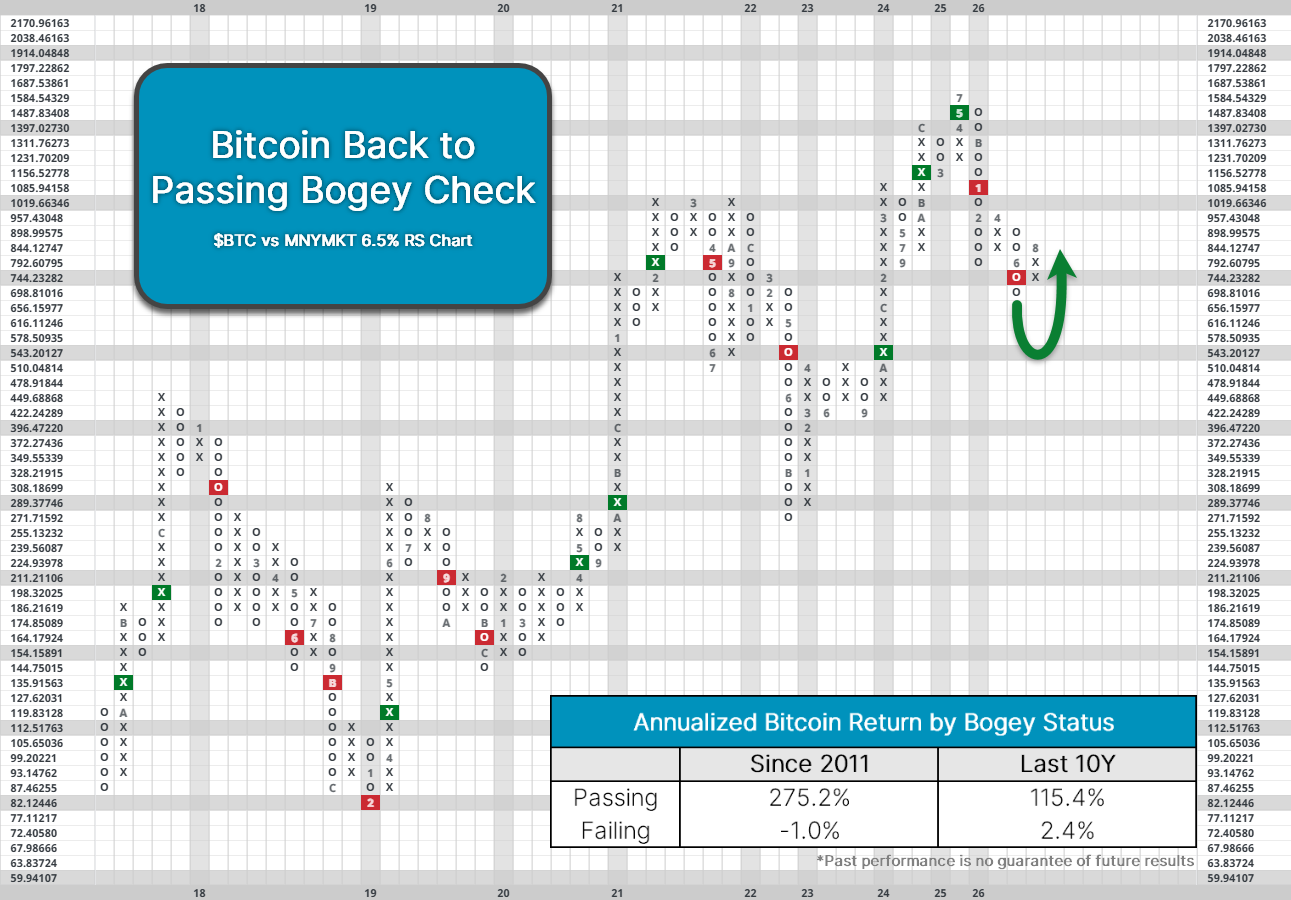
With all that said, both the bogey check and moving averages are more sensitive indicators of strength and aren’t as helpful in gauging the longer-term outlook for the asset. Unfortunately, less sensitive indicators for Bitcoin show that it still has room to improve.
The market RS chart for Bitcoin has historically been one of the best indicators of Bitcoin’s long-term strength. If you invested $100 in Bitcoin at the beginning of 2012, it would now be worth approximately $1.8 million (wouldn’t that be nice). However, if you had rotated between Bitcoin and SPXEWI based on RS buy signals, you would have made more than triple that, with the investment growing to $7.2 million. While Bitcoin regained near-term market relative strength last week, domestic equities continue to hold long-term strength against Bitcoin. Additionally, IBIT’s fund score has risen more than two and a half points over the last month, but its overall level remains below the acceptable 3.0 threshold for now.

Overall, the outlook for Bitcoin is dependent on how you want to trade it. Very active traders willing to ditch positions quickly could begin to add here given the positive stance of the short- and intermediate-term indicators. Meanwhile, longer-term investors might be better off waiting for more signs of sustained improvement before entering.
