
International equities have fallen in DALI but the overall momentum environment within the space remains quite productive. We discuss how to take advantage of this in today's featured article.
One of the most famous sayings around the NDW office is the idea that “assets go in and out of favor like produce at the supermarket”. At its core, this simply means that stocks can naturally rotate as simply as your fruits and veggies at your local grocery store. After all, even the novice chef understands that a lower supply of seasonal berries in the winter means a higher price at checkout… and typically worse taste at the dining room table. This principle is the centerpiece of virtually every one of Dorsey Wright’s strategies—picking your “seasonally accessible” stocks and leaving your “seasonally out-of-favor” on the trading room floor. You’ll see this concept in play in our models, TA scoring system, etc. Since most of us deal primarily with domestic equities, it is easy to think about utilizing momentum solely on the domestic front. However, the practice of finding the “in-season assets” can be put in play around the globe. Today’s feature will discuss utilizing this momentum backed approach on the emerging front, which despite a bit of a downtick off highs, remains a largely productive environment for trend followers.

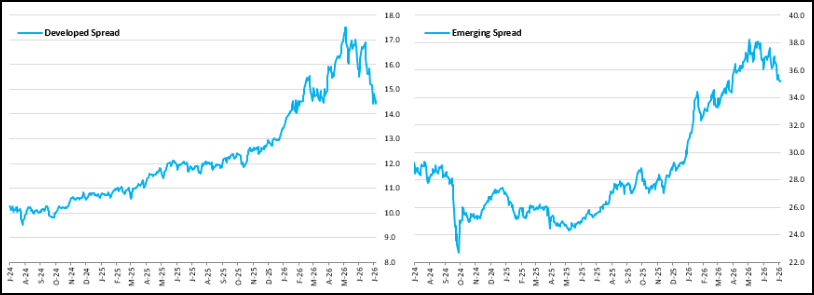
The phrase “productive for trend followers” can be a bit vague. The NDW analyst team uses relative strength (RS) spreads to quantify the difference in strength between high RS names and low RS names. Put simply, a larger spread implies a wider dispersion between winners and losers, which could lead to a more productive environment for momentum backed strategies. We reference these spreads from time to time, most recently discussing the slight contraction of RSSPREAD as some rotation occurred off recent highs. RSSPREAD quantifies the dispersion on the domestic front, but we can run a similar test on the international front. Those values are included below, showing the developed spread on the left and emerging on the right. While both spreads have slipped slightly (signifying less leadership from high RS names) the emerging spread has shown some more resilience in the space. While we won’t focus on it at length today, broader participation has continued to expand on the emerging front, evidenced by a reversal higher by ^BPMUEMRGE@2, signaling more emerging funds trading on PnF buy signals. It is also worth noting that as of 8/18, Domestic Equities managed to overtake International Equities within the NDW DALI rankings, pushing internationals to second. However, both groups still outpace 3rd placed commodities by a wide margin and see buy signal counts meaningfully above their low water marks from 2026. Said more plainly, despite the movement in overall rankings there remains an array of technically strong options within internationals- options we will look to highlight through the rest of this piece.
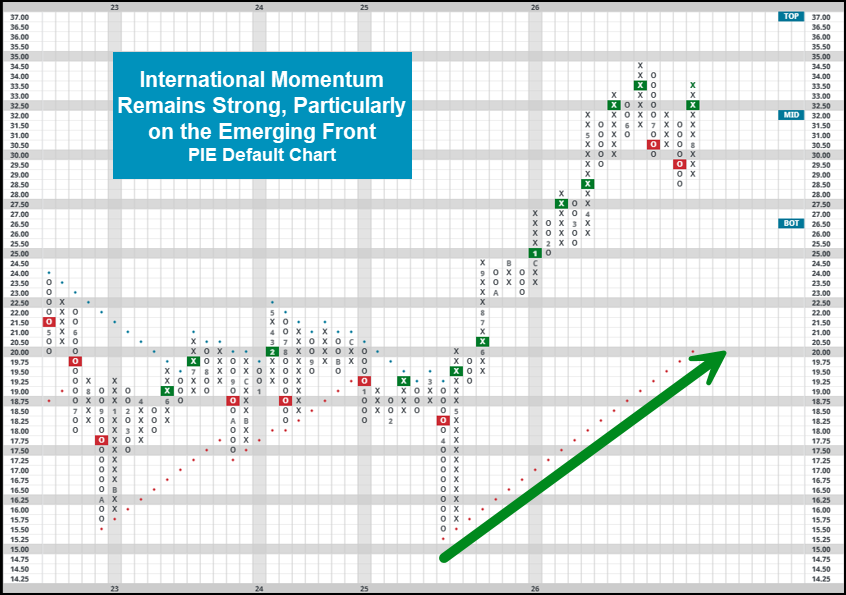
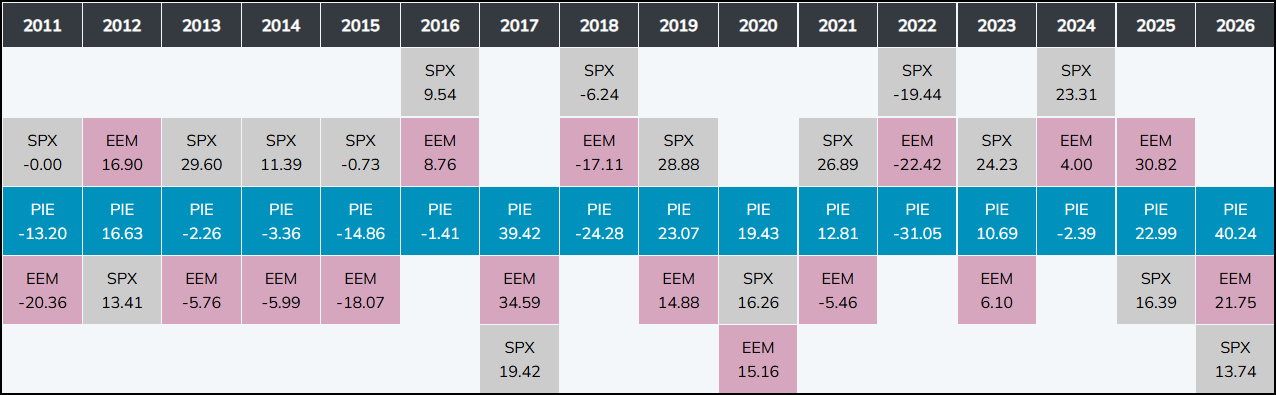
Knowing that a more productive trend following environment exists is one thing—taking advantage of it is another. The Invesco Dorsey Wright Emerging Markets Momentum ETF (PIE) aims to do just that, deploying a relative strength overlay to a basket of emerging market stocks to select those assets that are “in-season.” You can read more about the selection criteria and recent changes in our most recent quarterly update, linked here. PIE holds a near-perfect 5.89 fund score, outpacing broad emerging benchmark EEM by nearly 2-full points (3.95 fund score as of 8/18). PIE has gained ~42% so far this year, roughly double that of EEM (12/31/25 - 8/17/2026).
Diving underneath the hood, we can focus on the differences between the funds and their respective underlying holdings using NDW’s fund comparison tool. Focusing on the country exposure first, we can see that the tactical nature of PIE is leading it to heavily overweight Taiwan (49% vs. 22.5%) and South Africa (5.0% vs. 2.9%). Of course, where you overweight isn’t the only important item—we have found that underweighting specific areas can also be quite important to the long-term success of a strategy. Notable differences include EEM’s ~14% allocation to India, a group which finds itself with no representation within our strategy as of 8/17 as the space is a point of weakness. China (mainland and Hong-Kong) and South Korea are also notable underweights. We can complete the same practice from a sector perspective, where industrial names stand out as a large overweight in PIE vs. EEM. It is also important to emphasize that momentum strategies are self-correcting. If one asset out (under) performs for long enough, it will rotate in (out) of the underlying holdings over time.
Disclosures:
This article is intended for Financial Professional Use Only.
Management and other expenses can have a material impact on performance when compounded over time. Past performance, hypothetical or actual, does not guarantee future results. In all securities trading there is a potential for loss as well as profit. It should not be assumed that recommendations made in the future will be profitable or will equal the performance as shown.
Click here for more information from Invesco on the Invesco Dorsey Wright Emerging Markets Mo ETF (PIE): https://www.invesco.com/us/financial-products/etfs/product-detail?audienceType=Investor&ticker=PIE
