
An Earnings Filled Recap After Results from Major Banks got us Started this Week.
If you have been around NDW research long enough, you are likely familiar with the concept of “playing the piano with both hands” when it comes to identifying superior investments. No, we are not suggesting you break out a rendition of Chopsticks at your next client meeting, but rather try to combine strong technical and fundamental analysis when evaluating investment opportunities. While Dorsey Wright has traditionally focused on providing the tools and insights needed to identify stocks and funds with strong technical characteristics, we also recognize that many of you- and your clients- look for further fundamental support before making final investment decisions. One of the most significant intersections between technical and fundamental analysis occurs each quarter during earnings season, when updates on a company’s business performance can drive meaningful share-price reactions and, in turn, shifts in technical strength.

With earnings season now underway, we will take today’s feature to highlight several large names that recently reported as well as provide some commentary for a handful of household names reporting over the next few days. We will also remind you to watch for our “Technical Earnings Review” we update at the end of each earnings season, highlighting notable shifts from each sector across NDW’s technical attribute scoring system.
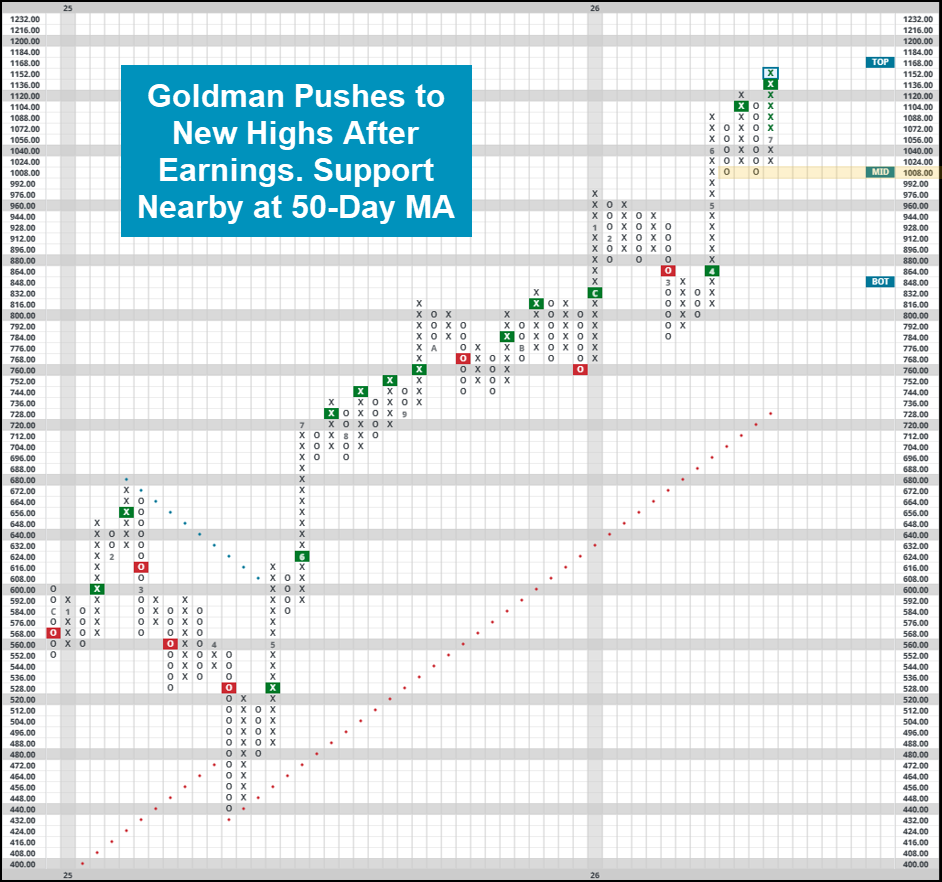
As usual, earning season started up with the big banks. The likes of JPM, GS, BAC, WFC, & C got us started up on Tuesday morning. Reactions for this group were largely productive, highlighted by a 9%+ day for GS which beat handedly on both top and bottom line results. Lowlights for the day included a 5%+ decline for Citigroup, which struggled despite beating expectations. Regardless, it is worth noting that all these names earn “technically acceptable” scores (>=3 Technical Attributes) as of 7/14. These previously mentioned “blue blood” banks are joined by the likes of Blackrock (BLK) and Morgan Stanley (MS) which report on 7/15. The image below features GS whose shares moved higher on 7/14 and broke a double top at $1,136 to mark a fresh buy signal. This 5 for 5'er sits at a matrix rank of 10/70 within the Wall Street sector. GS shares were trading in actionable territory but have moved sharply into overbought conditions over yesterday’s session, with the weekly overbought/oversold reading jumping from 16.83% on 7/14 to 75.18% on 7/15. From here, support is offered at nearby at $1,080. Pullbacks out of this overbought position would be constructive.
It is worth noting the disconnect between apparent strength in banks and other areas of the financials group. While XLF is still defendable by all accounts as it earns a 3.98 fund score as of 7/14, its meager 2.37% gain so far in 2026 lags a more banks-focused proxy like DWABANK which has gained over 17% YTD. The likes of Visa (V), Mastercard (MA) or Berkshire (BRK.A, BRK.B) appear to be the main points of difference between the two, a point worth monitoring when looking for financials exposure. Elsewhere around the platform, the Financial-Banks Asset Class Group Score of 4.01 sits noticeably above the broader Financials group score of 3.32. Weakness from payment processors could earn its own featured article outside the scope of this conversation…. For now, our point is largely that there is a noticeable difference in strength between diversified financials and focused bank exposure.
Banks aren’t the only areas to report results. Other companies reporting throughout this week include Johnson and Johnson JNJ & ASML Holdings (ASML), both of have already reported as of Wednesday’s trading. Coming down the pipeline throughout this week (and early next) include the likes of Taiwan Semiconductor (TSM), UnitedHealth Group (UNH), Netflix (NFLX), GE Aerospace (GE) & Alphabet (GOOG, GOOGL). While each one of these names has their own unique picture, perhaps of greatest interest would be TSM. The contraction for semiconductors has been rather intense to open Q3, seeing TSM return to a PnF sell signal on its default chart. Despite this, it remains a technically strong 5/5’er in a similar fashion to other areas of the semi space. From here, interested parties will watch the next level of support ranging from $408-$388.
Remember, earnings season can be a useful touchpoint with clients as you remind them how you are keeping their portfolio safe around large moves. Remember to use the alerts function on the chart to be notified of important breaks on the charts.

