There are changes to four Invesco models this week.
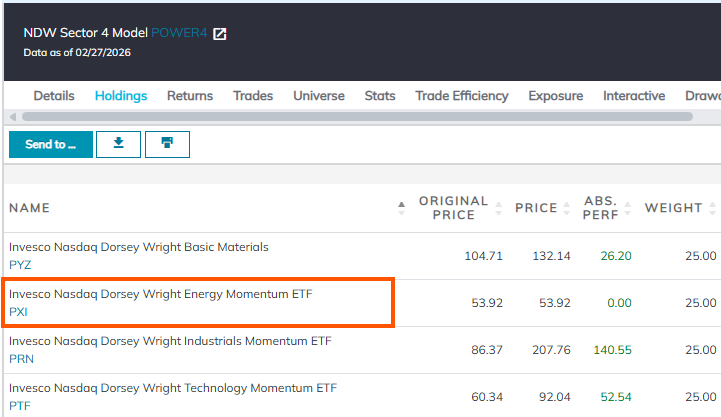
There are changes to four Invesco models this week. The NDW Sector 4 Model (POWER4) sold the Invesco NDW Financial Momentum ETF (PFI) and bought the Invesco NDW Energy Momentum ETF (PXI). PFI was sold because financials dropped out of the top four in the model’s relative strength sector rankings. In its place, the model added PXI as energy has moved into the top three in the rankings. PXI currently has a favorable 4.44 fund score and a positive 3.35 score direction. Year-to-date (through 2/27) the fund has gained 19.22% on a price return basis and carries a 1.6% yield. In addition to PXI, POWER4 also has exposure to materials, industrials, and technology. Year-to-date, the model has gained 13.92% while the S&P 500 (SPX) is up around 0.5%.
The Invesco Dynamic Equal Weight Sector Model (GUGGEWSECT) sold the Invesco S&P Equal Weight Technology ETF (RSPT) and bought the Invesco S&P Equal Weight Energy ETF (RSPG). RPT was sold because technology dropped out of the top three in the model’s sector rankings. Meanwhile, RSPG was added as energy has moved into the top three in the rankings. RSPG currently has a favorable 4.58 fund score and a positive 3.66 core direction. Year-to-date, the fund has gained 25.38% on a price return basis and carries a 2.3% yield. In addition to RSPG, GUGGEWSECT also has exposure to industrials and materials. Year-to-date, the model has gained 7.9%.

The Invesco Special Opportunities Model (GUGGSO) sold the Invesco China Technology ETF (CQQQ) and bought the Invesco S&P Spin-off ETF (CSD). CQQQ was sold because its rank in the model’s relative strength matrix fell below the threshold to remain a holding in the portfolio. In its place, the model added CSD as it was the highest-ranking fund in the matrix that was not already a model holding. CSD currently has a near-perfect 5.91 fund score, and a positive 1.08 score direction. Year-to-date, the fund has gained 21.14% on a price return basis. In addition to CSD, the model also has exposure to buybacks, the S&P 500, the S&P 500 top 50, and solar. Year-to-date, the model has gained 1.39%.

The NDW Global Factor Model (GLOBALFACTOR) increased its exposure to the international equity funds in its inventory and reduced its exposure to its domestic equity funds. This change occurred because international equities now rank ahead of domestic equities in the DALI asset class rankings. Because domestic equities are in second place in the DALI rankings, domestic momentum is still overweight relative to domestic low volatility. If domestic equities ranked third or lower low volatility would be overweight relative to momentum. Similarly, because international equities rank first, international momentum is overweight relative to international low vol. Year-to-date, GLOBALFACTOR has gained 9.93%.

