Markets were extremely mixed in July.
Markets were extremely mixed in July depending on which index or area you looked at. The S&P 500 (SPX) only declined 0.13%, but not every group was that lucky. Growth areas, particularly the largest stocks, were hit quite hard as the Nasdaq-100 (NDX) fell 6.61% during the month. This saw the index briefly enter correction territory trading at levels more than 10% below prior highs.

Worries over AI spending plagued the market, with most AI-focused companies and stocks taking the brunt of the damage. Semiconductor companies were previously an area of extreme leadership, but the VanEck Semiconductor ETF (SMH) dropped almost 17% during the month. The broader technology sector also took a hit, as the Select Sector Technology SPDR fund XLK shed 7.7%, bringing the sector into correction territory. Despite the recent woes, technology continues to demonstrate long-term relative strength. While the sector no longer sits at the top of our rankings, it still rounds out the top three, currently ranking behind only industrials and healthcare. It will be important to monitor how the sector moves if markets bring a more extended exhale.
Encouragingly, we did see a broadening of the market despite pullback from the market’s largest companies. The average S&P 500 company, represented by the equal weight index (SPXEWI), gained 1% during the month. Moreover, over two-thirds of the S&P 500 trades in a positive trend, as measured by NDW’s ^PTSPX indicator. More stocks participating in upside is constructive for markets, as it’s easier for indices to rise when more stocks are gaining ground. Meanwhile, non-technology areas like healthcare and financials picked up steam, with both sectors sitting in overweight territory in our rankings.

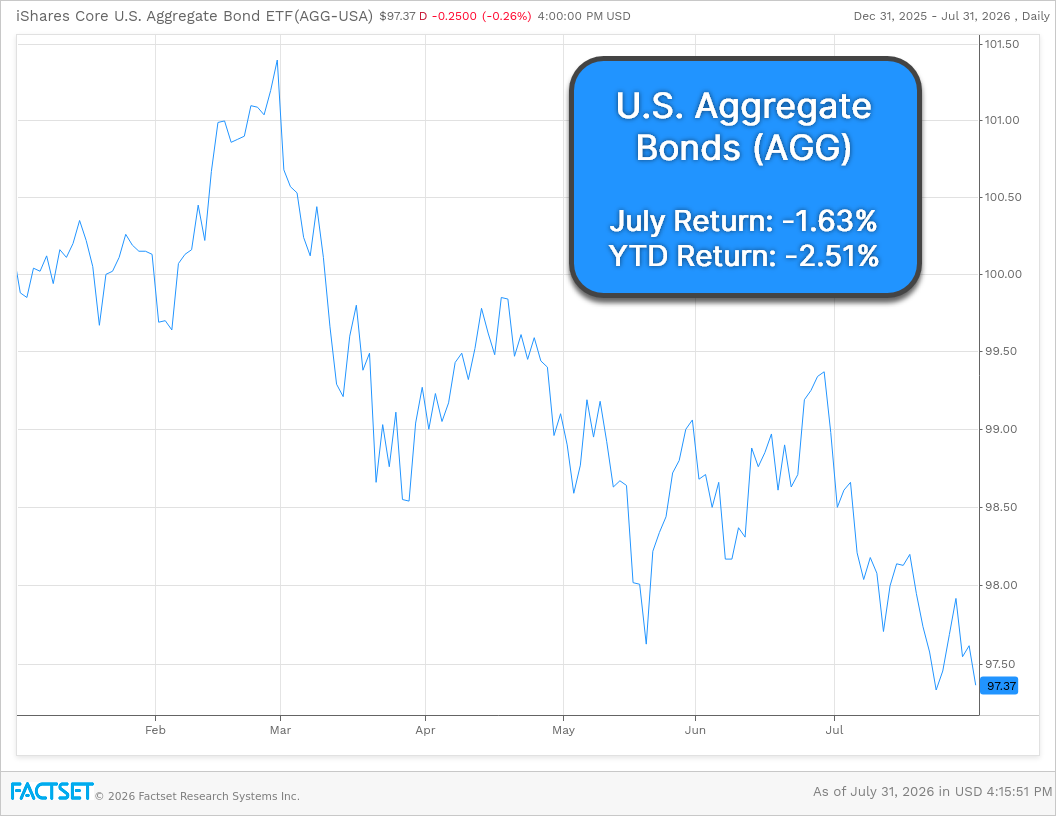
The economy has seen headwinds from sustained global conflict, pushing inflation expectations slightly higher. The Federal Reserve’s stance has become increasingly restrictive, with the Fed now expected to increase rates as soon as next month. With inflation and fiscal sustainability concerns persisting, long-term government interest rates have also pushed higher. The ten-year Treasury yield moved to its highest level in over a year, ending the month at around 4.75%. Higher yields decrease the prices of existing bonds, causing the iShares US Core Bond ETF (AGG) to fall 1.6% in July. Overall, the outlook for the bond market looks more negative than positive, but they still serve a purpose in most portfolios given their income and diversification benefits.
Despite market uncertainty, corporate earnings remain exceptionally solid. Q2 earnings for the S&P 500 are currently 37.9% higher than they were in Q2 of last year, putting growth on pace for the highest rate since Q3 2021 (source: FactSet). If things continue, this quarter will be the second straight with at least 20% growth and the seventh consecutive quarter with double-digit growth. Strong earnings continue to provide a constructive backdrop for domestic and international equities, which aligns with their status as the highest relative strength asset classes.
